
 ENG
ENG
 English
 عربى
عربى Español
 中文简体
中文简体
Quoting a batch of worn mixer shafts, fifty corrosion-scored valve stems, and a set of pump rods rarely ends with one obvious process choice. The parts need real coating thickness, the budget cannot absorb powder-based spraying on every piece, and paint will not survive the duty cycle. Arc wire spray exists for exactly this gap. As a rule of thumb: when a job needs a thick metallic coating, high deposition speed, and low cost per kilogram, and the service condition is corrosion or moderate wear rather than hard-particle erosion, twin-wire arc spraying is usually the most economical route. The sections below explain how the process works, where it beats the alternatives, which wire materials to specify, and what to verify before you sign a purchase order.
Content
How Arc Wire Spray Works, and Why It Is Fast and Economical
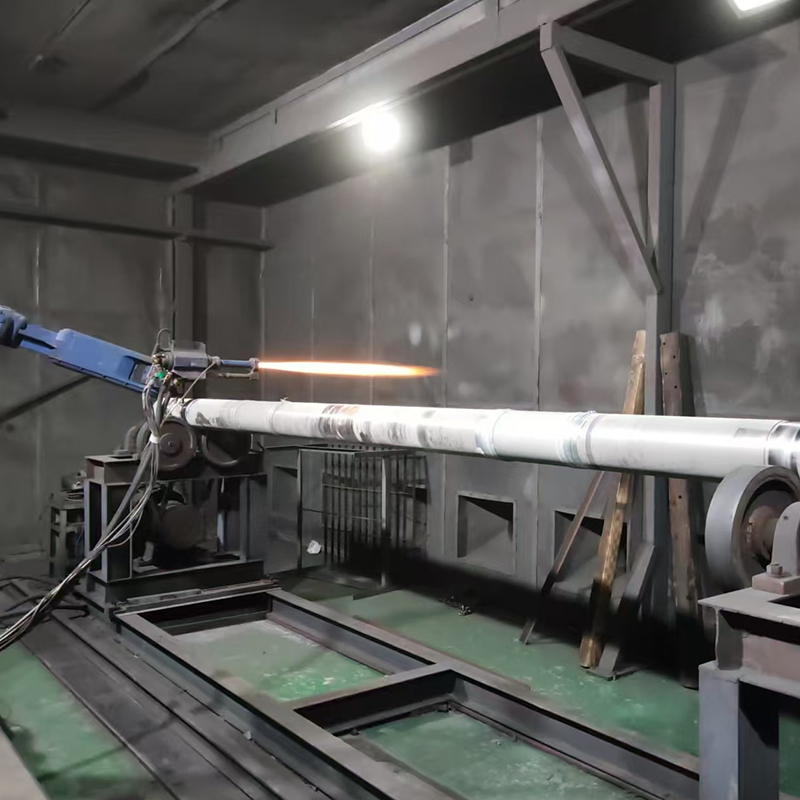
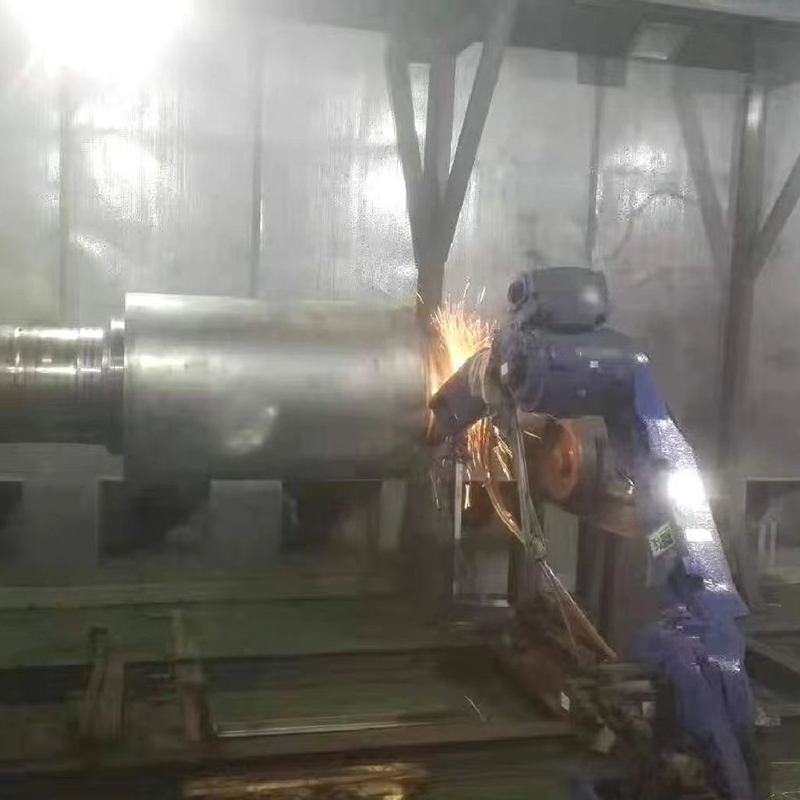
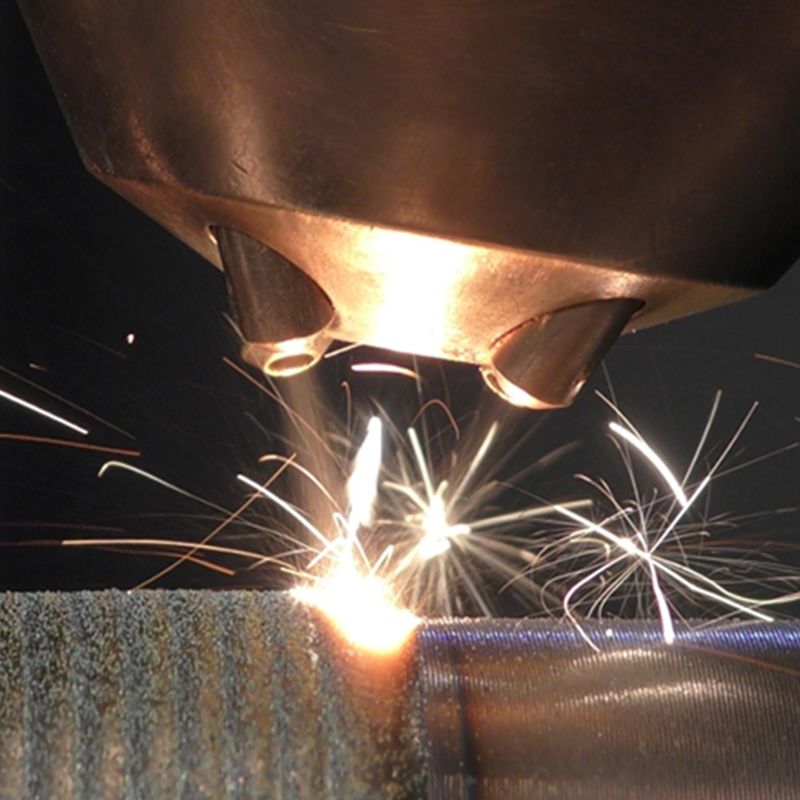
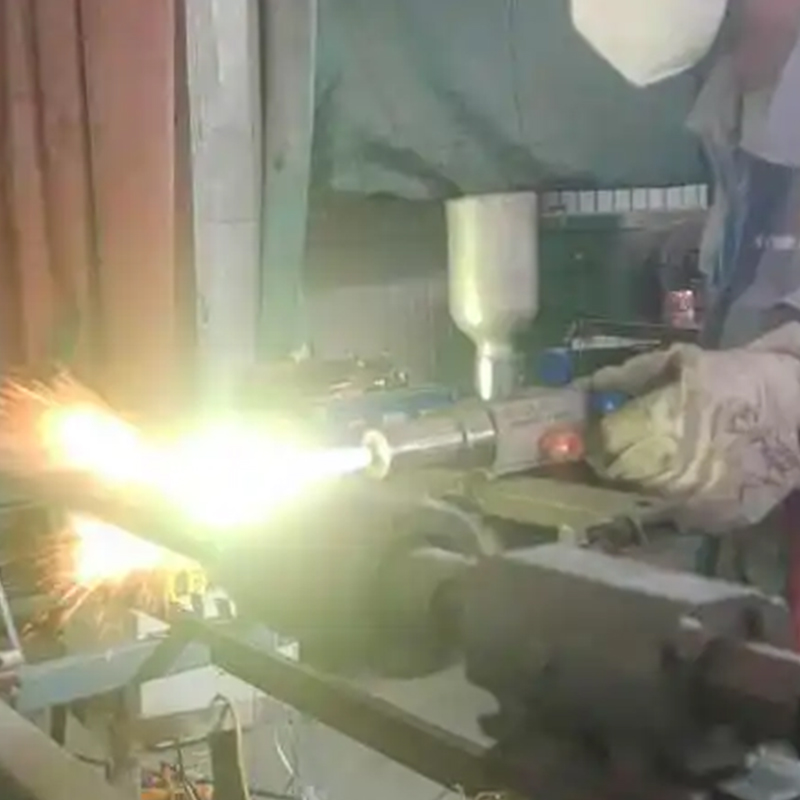
The process melts metal directly with electricity. Two consumable wires, insulated from each other, are fed through guide tubes and meet at an angle ahead of the nozzle. A DC arc, typically 18 to 40 volts and 100 to 300 amps, burns between the wire tips and keeps them molten. A jet of clean, dry compressed air then atomizes the melt into fine droplets and drives it onto a grit-blasted surface, where each droplet flattens and solidifies within milliseconds into a lamellar coating.
Three consequences follow from that design. Energy goes straight into the wire, so no combustion gas is consumed, and deposition rates commonly reach 5 to 15 kilograms per hour for steels, with far higher figures for zinc and aluminum. Wire feedstock costs a fraction of comparable powders, which is why arc-sprayed layers are consistently the cheapest metallic coatings per unit of thickness. And because the expanding air cools the spray stream, the substrate normally stays below about 150 degrees Celsius, so there is no distortion, no change in base-metal structure, and no risk to heat-treated parts.
For readers who want the wider context, our guide to the principles and processes of thermal spraying technology explains how arc spraying relates to flame, plasma, and HVOF methods, and when each is selected.
Arc Wire Spray Compared With Other Thermal Spray Processes
The short version: arc wire spray owns the high-rate, low-cost end of the thermal spray spectrum, while HVOF and plasma own the high-density, high-hardness end. Correct selection is mostly a matter of matching the required coating density and hardness against area, thickness, and budget.
| Process | Feedstock | Deposition rate | Relative cost | Typical porosity | Typical bond strength | Best suited for |
|---|---|---|---|---|---|---|
| Arc wire spray | Two metal wires | Very high | Low | 2-10% | 10-30 MPa | Large-area corrosion protection, thick rebuilds |
| Wire flame spray | Single wire, oxy-fuel flame | Moderate | Low | 5-12% | 5-15 MPa | On-site repair, lighter-duty build-up |
| Powder flame spray | Powder | Low | Moderate | 5-15% | 5-20 MPa | Small parts, low-melting alloys, touch-ups |
| HVOF | Powder | Moderate | High | Below 1-2% | Over 70 MPa | Dense carbide coatings, severe wear |
| Plasma spray | Powder | Moderate to high | High | 1-5% | 20-60 MPa | Ceramics and high-melting-point materials |
Read the table against the duty. If a mixer shaft needs two millimeters of machinable stainless build-up, plasma-level density is money wasted. If a slurry impeller faces sharp particles at high velocity, arc-sprayed porosity disqualifies the process and an HVOF tungsten carbide coating is the defensible specification. Many practical jobs combine both approaches: arc wire for fast, economical bulk restoration, then a denser process only on the final working surface.
Where Arc Wire Spray Delivers the Most Value
Large-Area Anti-Corrosion Protection
Thermally sprayed zinc, aluminum, and zinc-aluminum alloys are the flagship application, specified worldwide under ISO 2063 for steel bridges, tank shells, marine structures, and boiler water-wall tubes. For bare steel exposed to weather, splash zones, or continuous moisture, a sealed 150 to 250 micrometer zinc-aluminum layer generally outlasts a high-build paint system, and 20-year maintenance intervals are routinely written into project specifications. Sealing with a low-viscosity epoxy is standard practice wherever chlorides are present.
The same economics apply inside rotating equipment. In pump and valve service, arc-sprayed stainless and bronze layers restore seats, sleeves, and stems at a fraction of replacement cost; typical part families are summarized in our pump and valve industry solutions.
Dimensional Restoration of Worn Shafts and Journals
If a shaft is scarce, expensive, or long-lead, restoration almost always beats replacement. Arc wire spray rebuilds bearing journals, seal seats, and worn diameters with anywhere from about 0.2 millimeters to several millimeters of coating, after which the layer is machined or ground back to the original tolerance. A worn 200-millimeter fan-shaft journal, for example, can be rebuilt in 316 stainless and finished to OEM dimension for well under the cost of a new forging. Our wear-resistant shaft work follows exactly this route.
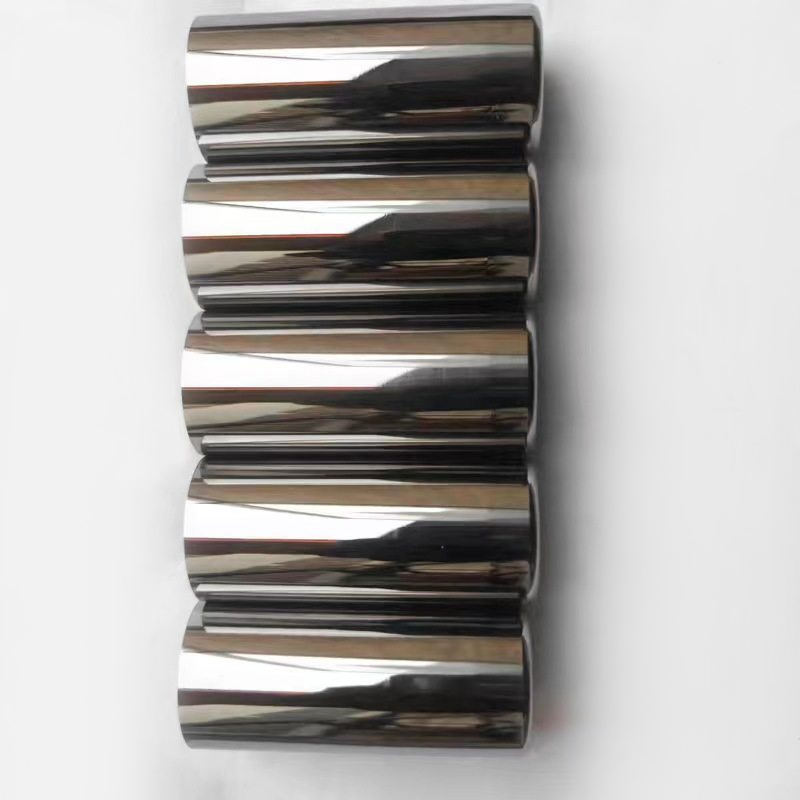 Wear-Resistant Shaft for Fans, Pumps and CompressorsMade from alloy or stainless steel with nitriding, induction hardening or sprayed coatings, this shaft keeps dimensional accuracy under continuous load—ideal for rebuilding worn journals instead of costly replacements.View Product →
Extrusion and Mixing Equipment Components
Screws and rotor assemblies in mixing and extrusion service suffer combined abrasion and corrosion along their working surfaces. Arc-sprayed stainless or cored-wire layers restore the worn profile and add a fresh service layer in the same operation, which is the principle behind our bimetallic coating screw for demanding mixing lines.
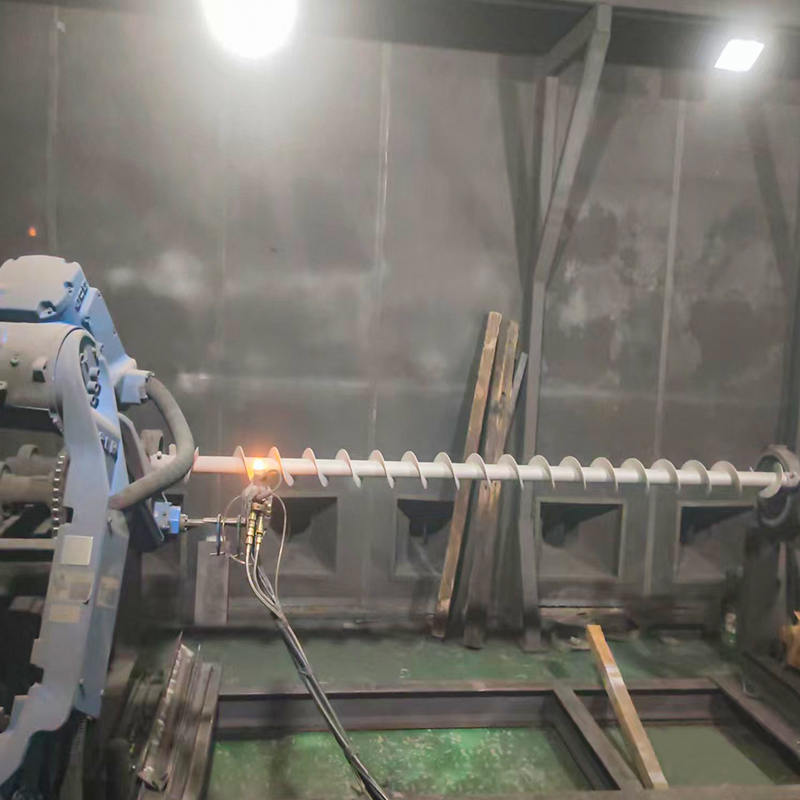 Bimetallic Coating Screw for Mixing and Extrusion LinesA steel or stainless base with an arc-sprayed bimetallic layer restores worn profiles while adding hardness and corrosion resistance, extending screw life in demanding mixing and extrusion service.View Product →
Conveying and Bulk Handling Parts
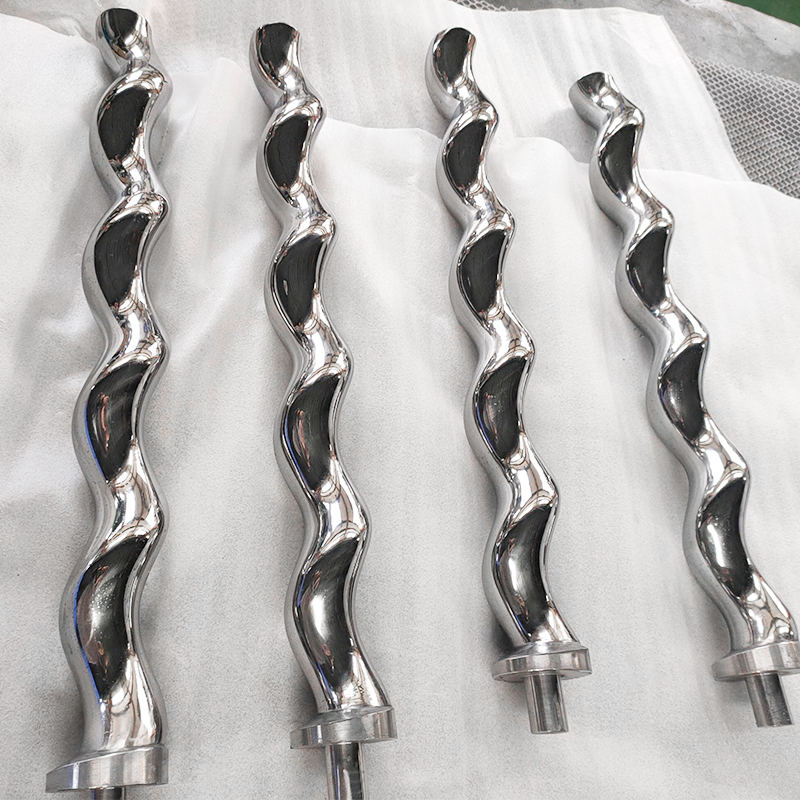
Conveyor screws and similar bulk-handling components see sliding abrasion around the clock. An arc-sprayed hard layer on the flight faces and root diameter extends service life substantially, as in our wear-resistant conveyor spiral shaft.
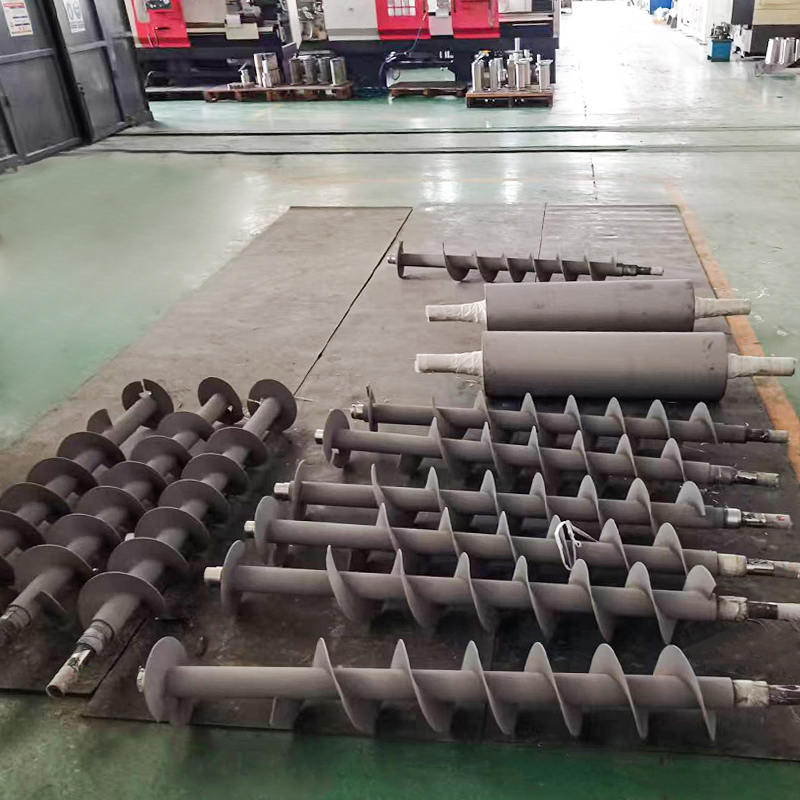 Wear-Resistant Conveyor Spiral Shaft with Tungsten Carbide CoatingTungsten carbide or metal-ceramic coatings sprayed onto the flight faces and root diameter protect conveyor screws against constant sliding abrasion, significantly extending service life in bulk handling.View Product →
Choosing the Right Wire for the Duty
Material selection determines more of the final performance than any process setting. These are the wires that matter in day-to-day work:
- Zinc: sacrificial protection for neutral waters and rural or marine atmospheres; the fastest and cheapest wire to spray.
- Aluminum: barrier protection stable in service temperatures up to roughly 500 degrees Celsius, common on high-temperature steelwork.
- Zinc-aluminum (ZnAl15): sacrificial and barrier behavior combined; the default where wet and dry cycles alternate.
- 304 and 316 stainless: corrosion resistance with moderate wear resistance, fully machineable; the workhorse for rebuild work.
- Carbon and low-alloy steels: economical build-up where corrosion is already handled by lubrication or seals.
- Molybdenum: high bond strength on smooth steel and proven anti-scuffing behavior on friction surfaces.
- Cored wires (FeCrC or carbide-filled): harder wear layers, at the cost of higher porosity and limited finishing options.
One caution: cored-wire arc coatings are considerably less dense than HVOF carbide. They suit sliding abrasion with some impact, but for severe slurry erosion or precision hydraulic surfaces, a denser process remains the correct specification.
What to Verify Before You Order
Most arc-spray failures trace back to preparation and records rather than the process itself, so a supplier's answers to five checks tell you most of what you need:
- Surface preparation: cleanliness to Sa 2.5 or Sa 3 under ISO 8501-1, an angular grit profile of roughly 60 to 100 micrometers, and spraying within a few hours of blasting before visible oxidation appears.
- Adhesion evidence: tensile bond testing to ASTM C633; 10 to 20 megapascals is a common acceptance band for steel build-ups, and lot-level reports beat generic datasheets.
- Thickness control: a stated minimum thickness and a finished machining band, for example 0.10 millimeters on a ground journal, with gauging recorded before finishing.
- Sealing: for immersion or chloride duty, a low-viscosity epoxy or phenolic sealer must be specified to penetrate residual porosity; an unsealed coating in such service is a red flag.
- Traceability: wire grades and lots, pass counts, interpass temperature, and finishing records retrievable per part number.
Name the procurement risks openly. Quotes based on wire consumption instead of finished coating thickness invite thin coatings. A shop whose only process is arc spray will default to it even where HVOF is needed, and a vendor without in-house machining quietly outsources the finishing, along with the accountability that comes with it. A useful screening question runs in reverse: ask a supplier when arc wire spray is the wrong choice. A multi-process manufacturer will answer with specifics.
Arc Wire Spray Capacity at Our Production Base
Our production base, operated by Xike (Yancheng) Surface Coating Technology Co., Ltd., covers 20,000 square meters in Dafeng, Yancheng, and was commissioned in 2025 with more than 200 employees and over ten production lines. Arc wire spray runs alongside HVOF, plasma spraying, flame powder spraying, wire flame spraying, laser cladding, and spray welding on the same campus, supported by in-house grit blasting, machining, grinding, and sealing, and governed by three major management system certifications.
Sharing one platform changes what is possible on difficult parts. We routinely split a job between processes: arc wire for fast, economical bulk restoration of a worn shaft or sleeve, followed by a denser HVOF or plasma layer only where the working surface demands it. Send us your drawings, service conditions, and target tolerances, and our engineers will specify the process, wire, and acceptance criteria before quotation.
The practical summary is short. Specify arc wire spray when you need thick, metallic, corrosion-resistant or restorable coatings over meaningful areas, and your duty is corrosion or moderate wear. Move to HVOF or plasma when density, hardness, or extreme wear govern the design. Whatever vendor you choose, demand documented preparation, adhesion, and sealing practice, because those three records predict coating life better than any brochure. If you would like a second opinion on a drawing or a failed coating, our engineering team is glad to review it.

 TOP
TOP